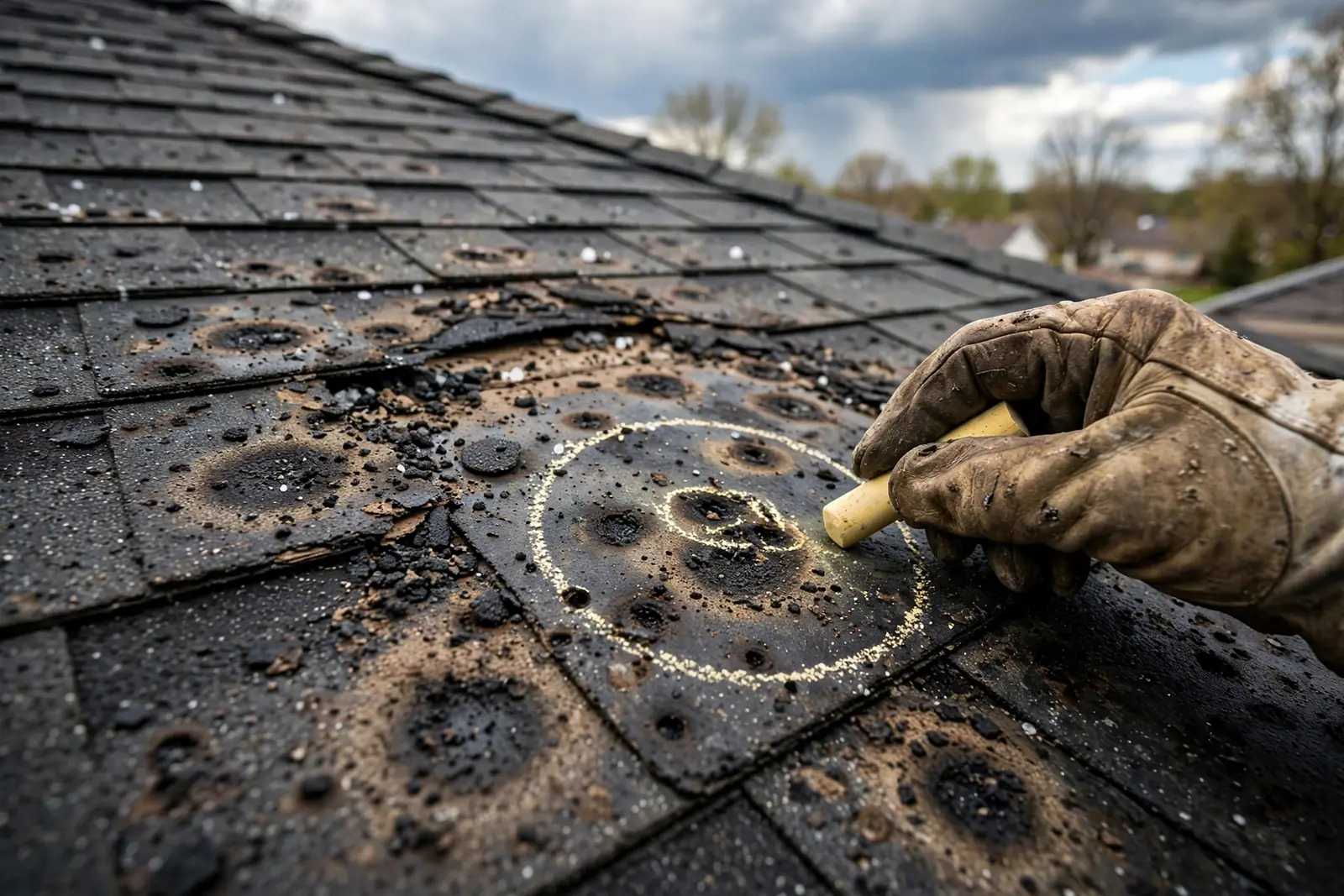
Northeast Indiana sits in the path of spring and summer storm systems that drop hail on one Fort Wayne neighborhood and skip the next street entirely. Hail damage is deceptive: from the ground your roof looks fine, while up top the shingles are bruised, cracked and stripped of granules — damage that does not leak today but shortens the roof's life by years and shows up as leaks two winters later, long after the claim window closes.
Roofer chalk-marking hail damage on asphalt shingles during a storm damage inspection in Fort Wayne IN.
Fort Wayne Roofing does storm work the way insurers and homeowners both need it done: a documented inspection with chalk marks and dated photos of every slope, tarping where water is already getting in, and an honest separation of storm damage from ordinary wear. If the damage supports a claim, our documentation is built for your adjuster. If it does not, we tell you that instead of filing you into a fight you cannot win.
Signs Your Roof Took Storm or Hail Damage
Dents in gutters, vents and soft metals
The easiest hail evidence is at ground level: dented gutter runs, creased downspouts, dinged vent caps and pocked AC fins. Soft metals dent before shingles show anything — if the metals around your house are marked, the shingles above them took the same stones.
Granules piled at the downspouts
A heavy wash of granules after a hailstorm means the stones knocked the protective surface loose across the slopes. Some granule loss is cosmetic; the pattern and volume after hail tells an inspector whether the shingle mat itself was bruised and fractured underneath.
Random bruises and cracks on the shingles
Hail hits land in a random pattern — no straight lines, no respect for rows — and leave soft bruises you can feel with a thumb, cracks in the mat, and shiny asphalt spots where granules were driven off. Randomness is exactly what separates hail damage from wear, blistering and foot traffic.
Missing, creased or lifted shingles after wind
The same storm systems bring the wind: shingles folded back, creased at the fold, or gone entirely, with the exposed underlayment weathering from the day it happens. Wind damage is time-sensitive — every rain works on the openings the storm left.
A new leak in the weeks after a storm
Hail fractures often leak slowly at first — a stain that appears a month after the storm, a drip only in hard rain. Insurers know this pattern well, but the connection between storm and leak has to be documented, and that gets harder with every month that passes.
Your neighbors are getting inspections
Hail falls in swaths, and storm dates are recorded to the street. If roofs on your block are being inspected or replaced after a dated storm, your roof stood in the same sky. An inspection costs you nothing and either confirms damage or gives you documented peace of mind.
How Storm & Hail Repairs Work — Our 5-Step Process
1
Emergency tarping first, if water is in
Active leaks and open damage get covered before anything else — a properly fastened tarp that sheds water without creating new holes. The house is protected while the paperwork catches up, not after.
2
Full documented inspection
Every slope is walked, test areas are chalked and counted, and hail hits, creases and collateral damage on metals are photographed with dates. You receive the full photo set — it is your roof and your claim, and the documentation belongs to you.
3
An honest claim conversation
We show you what we found and whether it supports a claim under a dated storm — and say so plainly if it does not. Filing is your decision and your call to your insurer; we never file on your behalf or pressure you to.
4
Adjuster meeting on the roof
When your adjuster schedules, we meet them at the property, walk the same slopes with the same chalk, and make sure the damage found is the damage recorded. Claims go better when both parties are looking at the same roof at the same time.
5
Repair or replacement to the approved scope
Approved work is done to the scope — repairs where repairs are right, replacement where the damage is slope-wide — with the same itemized pricing and cleanup standards as any of our jobs, and photos of the finished work for your file.
What Does Storm & Hail Roof Repair Cost in Fort Wayne?
Out of pocket, storm repairs follow the same published ranges as any roof repair — most jobs $150–$1,500, with full replacements around Fort Wayne's typical $9,600 (range $5,900–$13,400) when hail has damaged whole slopes. The difference with storm work is who pays: damage from a dated hail or wind event is normally a homeowners-insurance claim, and the homeowner's share is the deductible — commonly $1,000 or more, with some Indiana policies using a percentage-based wind/hail deductible.
Two cautions belong in every storm conversation. First, deadlines: most policies require claims within a set window after the storm (often a year), and late discovery is the most common reason valid damage goes unpaid. Second, storm chasers: after every big Fort Wayne hail event, out-of-state trucks arrive offering to 'handle everything.' Some are fine; many are gone before the first leak. A local company with a local phone number is the one still here when the warranty matters.
Why Fort Wayne Homeowners Choose Fort Wayne Roofing
Storm work is where this industry's reputation gets made and lost, so we keep our rules simple: we document before we sell, we tell you when damage is wear rather than storm, and we never promise what an insurer will approve — that decision is theirs, and anyone who guarantees it is guessing with your claim.
What we do guarantee is the quality of the evidence. Chalked test squares, slope-by-slope counts, dated photos of damage and collateral metals, and a written summary you can hand to any adjuster. Good documentation is what turns a storm from an argument into a process.
From the ground, check the soft metals first: dented gutters, downspouts, vent caps and AC fins. On the roof, hail leaves random bruises, cracks and granule loss that need a trained hand and eye to separate from wear. Our storm inspections are free and fully photographed either way.
Will insurance cover hail damage to my roof?
Generally yes — hail is a covered event on standard Indiana homeowners policies, and your cost is the deductible. What insurers require is documentation tying the damage to a dated storm. We provide that documentation and meet your adjuster on the roof.
How long do I have to file a hail claim?
Most policies set a window — commonly one year from the storm date — and it varies by company and policy. Because hail fractures often leak months later, getting the inspection done soon after a known storm is what protects your options. Do not wait for a leak to find out.
A storm company knocked on my door offering a free roof. Is that legitimate?
Be careful. Legitimate storm repair is real, but 'free roof' pitches, pressure to sign an assignment-of-benefits, and companies with no local address are the known patterns of storm chasers who leave town after the season. Verify the company is local, insured, and reachable — and never sign anything at the door.
Can hail damage be repaired, or does the whole roof need replacing?
It depends on density and distribution. A few hits on one slope may be repairable; damage spread across slopes — which is how hail usually falls — generally means replacement of the affected slopes or the full roof, and that is what insurers typically approve when the counts support it. Our inspection gives you the counts, not a guess.
Need Storm & Hail Damage Roof Repair in Fort Wayne?
Every storm that crosses a damaged roof makes the repair bigger — wet decking, soaked insulation, stained ceilings. We answer 24/7 across Fort Wayne and northeast Indiana — call now and get it covered, documented and scheduled, today.