Roofs rarely fail all at once. They fail at one vent boot, one lifted shingle, one seam of chimney flashing — quietly, for months, while the repair is still cheap. A roof inspection is how you find that one small failure on your schedule instead of your ceiling's. In northeast Indiana, where a roof takes hail in June and ice in January, an inspection every couple of years is not caution; it is arithmetic.
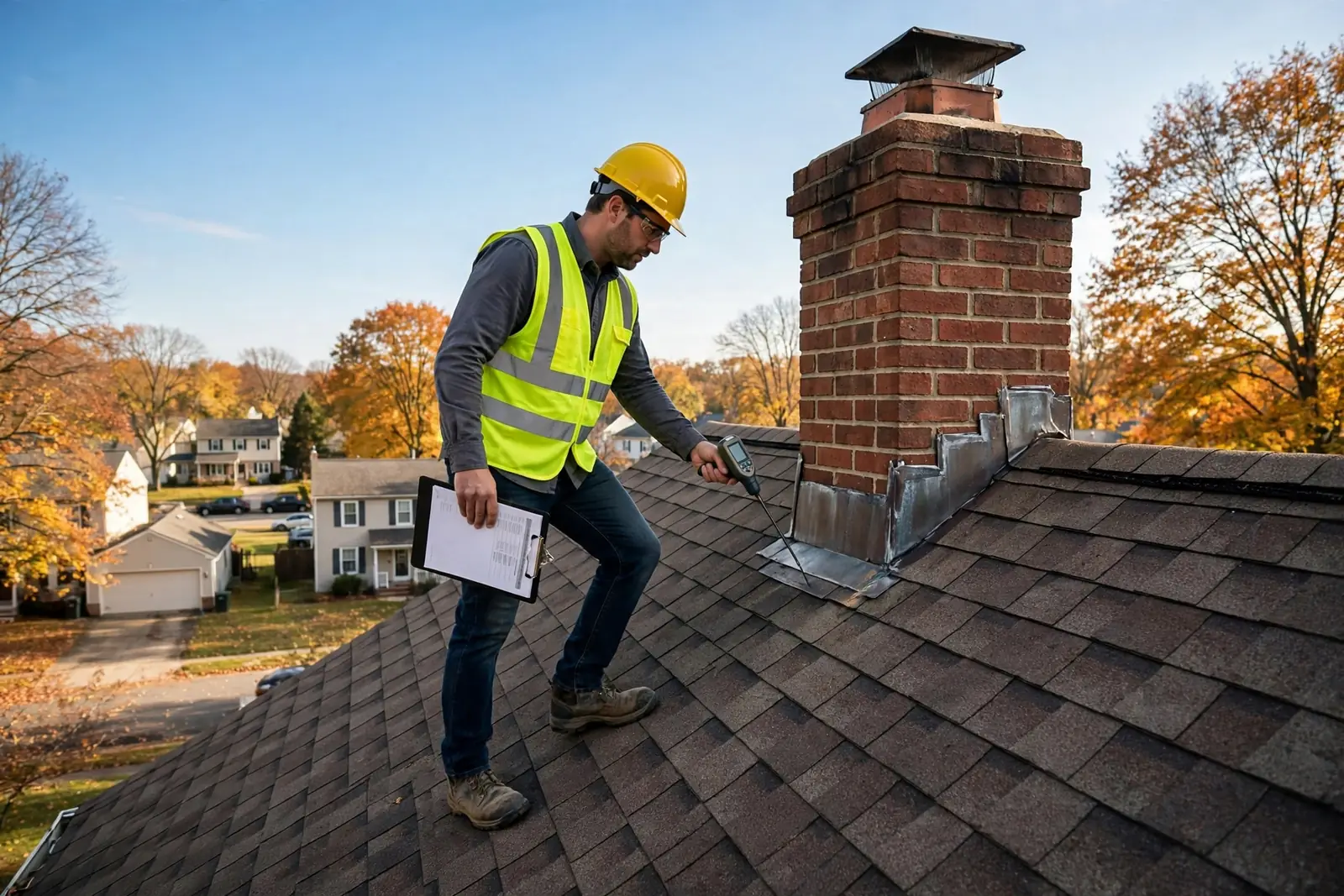
Roof inspector checking chimney flashing with a clipboard during a roof inspection in Fort Wayne IN.
Fort Wayne Roofing inspections are documented, not drive-by: every slope walked and photographed, flashing and penetrations checked one by one, the attic read for the leaks that have not reached a ceiling yet. Small fixes — a boot, a lifted shingle, open sealant — can be done on the spot, and everything else comes back to you as a written, photographed report with an honest estimate of the roof's remaining life.
When Your Roof Needs an Inspection
After any hail or major wind storm
Hail damage is nearly invisible from the ground and time-limited for insurance purposes. A post-storm inspection with dated photos either documents a claim while it is fresh or gives you written proof your roof came through — both are worth having.
The roof is past 12–15 years old
Mid-life is when the small components — boots, sealant, flashing — start failing while the shingles still have years left. Inspections in this window catch the cheap failures before they rot decking, which is where repair bills multiply.
You are buying or selling the home
A roof is the largest single system a home inspection generalizes about. Buyers get a real remaining-life number for negotiations; sellers get documentation that answers the roof question before it becomes the buyer's bargaining chip.
Stains, musty attic or higher energy bills
A ceiling stain is a late symptom; the attic usually knows first — damp decking, daylight at a penetration, mold on the north slope's underside. An inspection that includes the attic finds leaks in their cheap phase.
Shingles, grit or debris where they should not be
Tabs in the yard, granules at the downspouts, or a valley full of leaf dams holding moisture against the shingles — all are the roof asking for attention in writing. An inspection turns the hint into a specific, priced list.
Before winter, on an older roof
Ice dams exploit every weakness at the eaves, and a roof that enters January with lifted edges and tired sealant enters it vulnerable. A fall inspection and tune-up is the cheapest ice-dam insurance there is.
How Our Roof Inspection Works — Our 5-Step Process
1
Exterior ground and gutter review
We start from the ground: shingle condition by slope, gutter granule load, soffit and fascia staining, and the soft metals that record hail history. Half the roof's story is visible before the ladder comes out.
2
Full on-roof inspection
Every slope is walked. We check shingle condition and seal, lift-test sample edges, and inspect every penetration and transition — vents, boots, chimneys, valleys, walls — the places roofs actually leak from, one by one.
3
Attic inspection
From inside: decking stains and softness, daylight at penetrations, ventilation performance, insulation condition and any mold. The attic confirms what the surface suggests and catches what it hides.
4
Small maintenance done on the spot
With your approval, the cheap fixes happen during the visit: resealing exposed fasteners and flashing joints, replacing a cracked boot, reseating lifted shingles, clearing a choked valley. Most inspections end with the small list already shorter.
5
Written photo report and honest timeline
You receive the photos, the findings in plain language, anything that needs work priced in writing, and our straight estimate of remaining roof life — whether that is two years or fifteen. No findings are inflated to sell a roof; the report is written to be shown to insurers, buyers and other roofers alike.
What Does a Roof Inspection Cost in Fort Wayne, IN?
Published ranges for a professional roof inspection typically run from free promotional checks to about $350 for a full documented inspection, depending on roof size, pitch and whether an attic inspection and written report are included. Post-storm inspections tied to documented damage are commonly provided at no charge by local roofers, ourselves included, because the documentation serves everyone.
Maintenance pricing is itemized the same way: a vent boot, a tube-and-labor sealant renewal, a small shingle repair each carry a small, quoted price — the common tune-up items together usually land well inside the published $150–$1,500 repair range, at its low end. The economics are the point of the service: a $40 boot found in October is a ceiling, a deck section and a mold remediation you do not buy in March.
Why Fort Wayne Homeowners Choose Fort Wayne Roofing
An inspection is a trust product — you are paying for what we tell you, including when the answer is 'your roof is fine.' Our reports are deliberately written so a second roofer, an adjuster or a home inspector can verify every claim in them from the same photos. A company that expects to be checked inspects differently.
Maintenance is the other half of that honesty. Roofing is sold as replacements, but roofs are kept by maintenance: sealant renewed on its schedule, boots replaced before they split, valleys kept clear. A roofer willing to do the small work on time is the reason some Fort Wayne roofs reach thirty years while identical ones fail at eighteen.
How often should I have my roof inspected in Fort Wayne?
Every two years as a baseline, every year once the roof passes fifteen, and after any hail or severe wind event regardless of age. Northeast Indiana roofs take two distinct beatings a year — spring storms and winter ice — and inspection frequency should match.
What does your roof inspection include?
A ground and gutter review, a full on-roof inspection of every slope, penetration and flashing point, an attic inspection for leaks and ventilation, small maintenance items fixed on the spot with approval, and a written photo report with pricing for anything larger and an honest remaining-life estimate.
Will an inspection find a leak that has not stained my ceiling yet?
Often, yes. The attic check is designed for exactly that phase: damp or stained decking, rusted fasteners and daylight at penetrations all show up inside long before water crosses a ceiling. It is the main reason our inspections include the attic rather than stopping at the surface.
Do you provide inspection reports for home sales or insurance?
Yes — our written reports with dated photos are prepared to be handed to insurers, adjusters, buyers and lenders. For real-estate transactions we can usually schedule within a few days; tell us your closing deadline when you call.
If the inspection finds problems, am I obligated to hire you for the work?
No. The report and photos are yours, the pricing is itemized, and you can hand the whole package to any roofer. Most people do have us do the work — but the report is written to be useful even if you do not.
Need Roof Inspection & Maintenance in Fort Wayne?
Every storm that crosses a damaged roof makes the repair bigger — wet decking, soaked insulation, stained ceilings. We answer 24/7 across Fort Wayne and northeast Indiana — call now and get it covered, documented and scheduled, today.