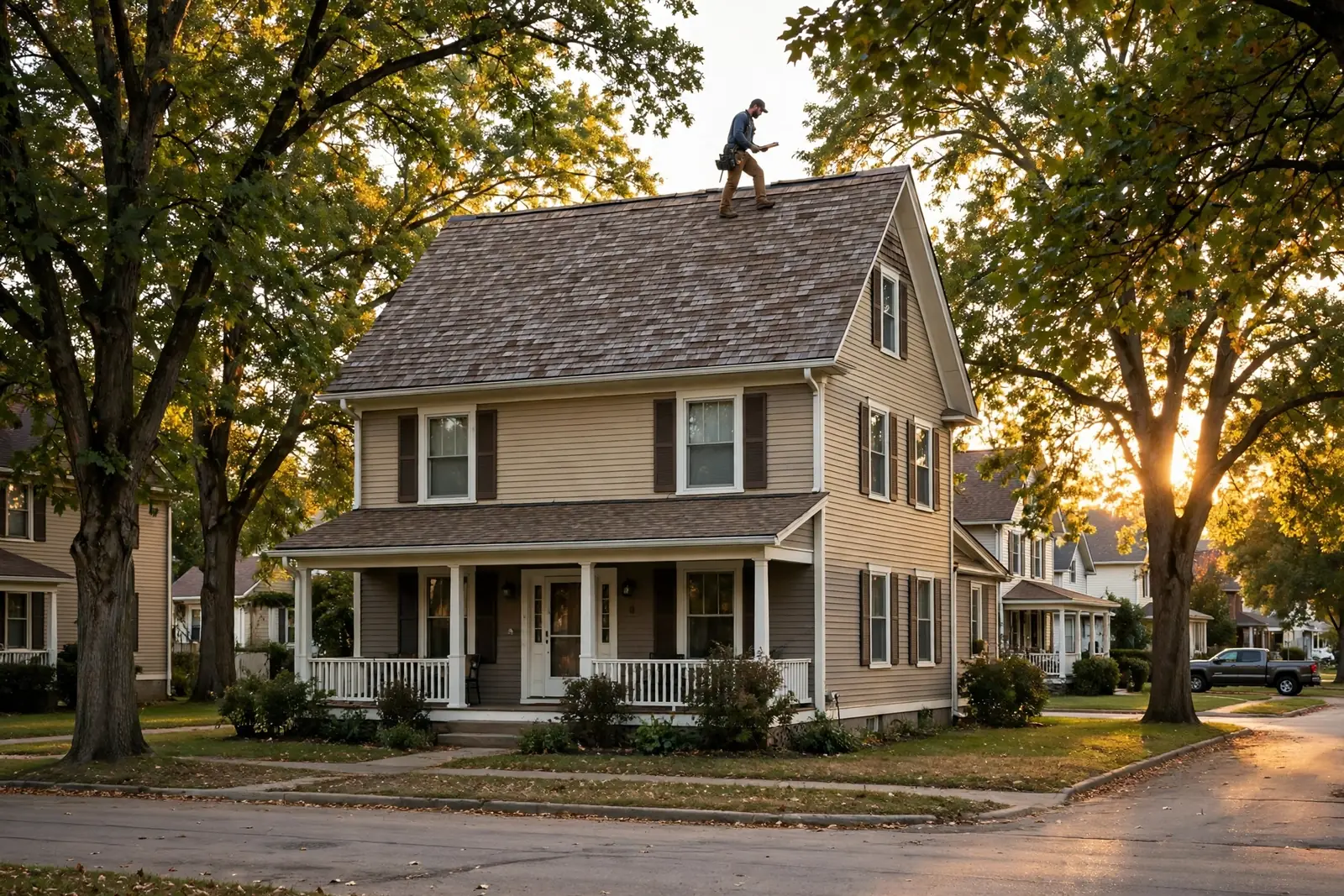
Asphalt shingles cover most roofs in Fort Wayne for good reasons: they handle Indiana's freeze-thaw winters, come in colors that suit everything from a 1920s West Central brick home to a new Aboite two-story, and deliver the best cost-per-year of any roofing material — when they are installed correctly. That last part is the whole game. The same shingle lasts 30 years on one house and 12 on the next, and the difference is almost never the shingle.
Finished architectural asphalt shingle roof on a two-story home in Fort Wayne IN.
Fort Wayne Roofing installs asphalt shingle roofs as a system: architectural (dimensional) shingles over synthetic underlayment, ice-and-water shield on the eaves and valleys, new flashing everywhere metal meets roof, and ventilation calculated for the attic — not whatever the last roofer left. The shingle is the part you see; the system is the part that keeps your ceilings dry.
Signs Your Shingle Roof Needs Attention
Granules in the gutters and at downspouts
Granules are the shingle's sunscreen. A light wash on a brand-new roof is normal break-in; heavy, continuing loss on an older roof means the asphalt underneath is exposed and aging fast. Gutter grit is the earliest, cheapest warning a shingle roof gives — if you know to look.
Curling, cupping or clawing edges
Shingles that curl up at the edges or claw down in the middle have dried out and lost their flexibility. In Indiana wind they are the first to fold and crease in a storm, and no sealant fixes a shingle that has gone brittle.
Bald spots and shiny patches
Areas where the granule surface is simply gone — often after hail, foot traffic or a pressure washer that should never have been on a roof — age in fast-forward. Bald shingles crack, and cracks become leaks on the next hard freeze.
Cracked or blistered shingles
Hairline cracks across the surface and raised blisters that pop open are manufacturing and heat-aging patterns. A few are cosmetic; a slope full of them means the roof is at the end of its service life and repairs will not hold.
Neighbors with the same-age roof replacing theirs
Subdivisions were roofed by the street, with the same material in the same years. When two or three houses on your block replace roofs the same age as yours, it is not a trend — it is the material reaching its limit on schedule. Worth an inspection before your ceiling confirms it.
Moss, algae streaks and staining
Black algae streaks are mostly cosmetic, but moss is not: it holds moisture against the shingles, lifts their edges as it grows, and in Fort Wayne's shaded, humid lots it shortens a roof's life. Moss means cleaning and treatment now, and a look at why that slope stays wet.
How We Install a Shingle Roof — Our 5-Step Process
1
Measurement, attic check and material selection
We measure the roof precisely, check the attic for ventilation and deck condition, and walk you through architectural shingle options and colors with real samples — including impact-resistant shingles worth considering in hail country.
2
Full tear-off and deck inspection
Every shingle job starts with the old roof off. The deck is inspected and any soft, rotted or delaminated sections are replaced — shingles nailed into bad decking are a leak scheduled for later.
3
Ice shield, underlayment and drip edge
Ice-and-water shield at the eaves (extended to Indiana ice-dam depth), in valleys and around penetrations; synthetic underlayment across the field; new drip edge so water leaves the roof instead of wicking under it.
4
Shingles installed to the manufacturer's pattern
Correct starter course, nail count and placement per shingle — the unglamorous details that decide whether the manufacturer's wind warranty applies — with new flashing at every chimney, wall and vent, and ridge cap finished clean.
5
Ventilation balance, cleanup and warranty papers
Intake and exhaust ventilation are balanced so the attic stops cooking the shingles from below. Then magnetic cleanup, a full-yard sweep, and your warranty documents in hand at the walk-through.
What Does an Asphalt Shingle Roof Cost in Fort Wayne, IN?
Asphalt shingles are the value option in Fort Wayne roofing: published local figures put a typical full shingle replacement around $9,600 for an average home, with most jobs between $5,900 and $13,400. Architectural shingles — the dimensional product on most new roofs — cost modestly more than basic three-tab and outlast them by years, which is why three-tab is rarely the right recommendation anymore.
Upgrades that move the price within that range: impact-resistant (Class 4) shingles, which some Indiana insurers reward with a premium discount; heavier premium designer lines; and the decking and ventilation corrections older homes often need. What should not move the price is mystery — our quotes itemize material, tear-off, decking allowance and flashing so you can compare line by line against any other bid.
Why Fort Wayne Homeowners Choose Fort Wayne Roofing
Two shingle roofs can look identical from the street and be ten years apart in real life. The difference lives in the parts hidden by the shingles themselves: ice shield depth, flashing, nail placement, ventilation. We photograph those layers as your roof goes together, so the quality of the invisible work is on the record — not a promise.
We are also straight about shingle limits. Asphalt is the right answer for most Fort Wayne homes, but a low-slope section, a roof under heavy tree cover, or a house you plan to keep for forty years may point to metal or a different detail. You will hear that from us before the quote, not after the deposit.
How long does an asphalt shingle roof last in Indiana?
Architectural shingles typically deliver 20–30 years in northeast Indiana; basic three-tab runs 15–20. Hail, poor attic ventilation and skipped maintenance shorten those numbers, while impact-resistant shingles and balanced ventilation push toward the top of the range.
Architectural vs three-tab shingles — which should I choose?
Architectural, in almost every case today. They cost somewhat more per square but last significantly longer, carry stronger wind ratings, look better on Fort Wayne's housing stock, and are what the market expects at resale. Three-tab survives mainly as a budget patch material.
Are impact-resistant shingles worth it in Fort Wayne?
Often, yes. Class 4 impact-resistant shingles stand up to the hail sizes northeast Indiana sees most springs, and some insurers offer a premium discount for them (ask yours — policies vary). They cost more upfront but can pay for themselves in one avoided hail claim cycle.
Can a new shingle roof go over my old one?
It can be legal in some cases, but we recommend against it: it hides deck rot, traps heat, adds weight and shortens the new roof's life. Tear-off is a modest share of the total cost and the single best investment in the new roof's lifespan.
What shingle colors work best on Fort Wayne homes?
Weathered wood, charcoal and driftwood tones dominate locally because they suit brick and siding alike and hide algae streaking better than light colors. We bring full-size samples to your home — a shingle looks different on your roof, in your light, than on a chart.
Need Asphalt Shingle Roofing in Fort Wayne?
Every storm that crosses a damaged roof makes the repair bigger — wet decking, soaked insulation, stained ceilings. We answer 24/7 across Fort Wayne and northeast Indiana — call now and get it covered, documented and scheduled, today.